Fish Scallops Oysters and Clams
OUT OF AFRICA
One Tribe Crossing the Gate of Grief Populated the World
"To Understand Who We Are & Where We Come From, We Must Look At Our genetic Heritage."
- Donald Glovery
Mitochondrial DNA is passed from mother to children, both male and female, unchanged and it mutates at a predictable rate; i.e., the more the genetic mutations in the DNA, the more ancient the origin of the population.
Using these facts, some scientists are studying mitochondrial DNA to try to trace back the origins of the human race.
Using this method, the scientists have traced the human race to one female in Africa several million years ago. Then they traced the migration patters of her descendants as they spread across the earth.
The Real Eve is a fascinating documentary presenting a new and controversial research of human evolution.
It makes you think, and it entertains at the same time.
http://bit.do/MCFSC-the-real-eve
http://www.youtube.com/watch?v=ffYTgJhSHUw&t=1282s
16:20
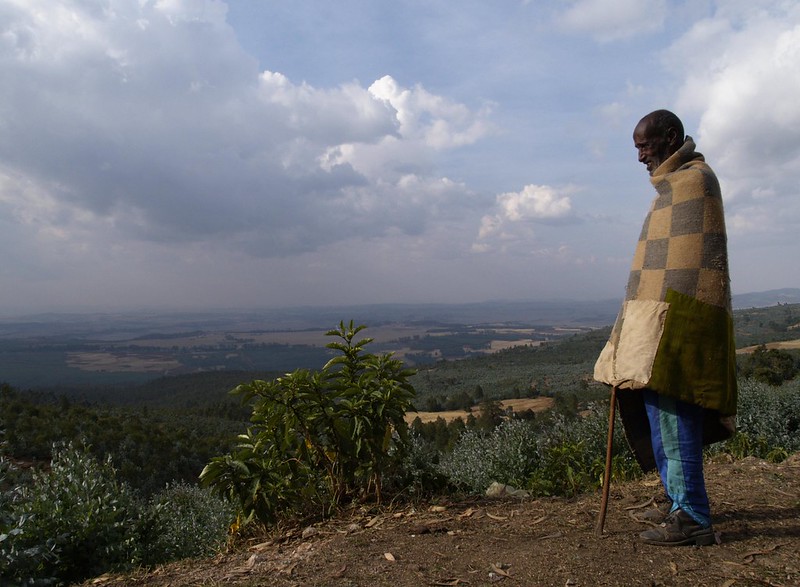
The entire human race outside Africa owes its existence to the survival of a single tribe of people who crossed the Gate of Grief between 80,000 to 90,000 years ago.
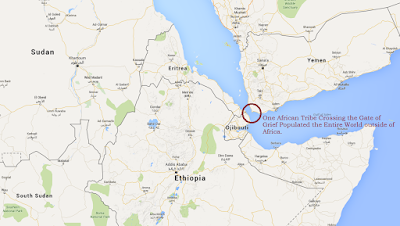
Today there is 18 miles between the coasts of Djibouti and Yemen across Bab-el-Mandeb also known as the Gate of Grief in Arabic. The Gate of Grief is between the Red Sea, one of the most saline bodies of water in the world and the Gulf of Aden an essential shipping waterway in the world economy.
The ancestral origin of humans was possibly located in southern Africa, near the South Africa-Namibia border. By using modern DNA Geneticists, trace the origins of Homo sapiens outside of Africa to a single tribe.
These ancestors managed to cross from the Horn of Africa and into Arabia through the Gate of Grief. There are 14 ancestral populations in Africa that are linked by ethnicity and shared cultural and language properties. One survived outside of the African continent and from there, just one tribe went on to inhabit the entire world.
There is more genetic diversity in Africa than anywhere else on earth. Dr. Stephen Oppenheimer, a geneticist at the school of anthropology at Oxford University said, "What you can see from the DNA of all non-Africans is that they all belong to one tiny African branch that came across the Red Sea. “If it was easy to get out of Africa, we would have seen multiple African lineages in the DNA of non-Africans but that there was only one successful exit suggests it must have been very tough to get out."
Humans were always driven by hunger, a shrinking habitat, curiosity and experience traveling.
Timing and route were determined by climate swings.
Before boats were invented, there would have been only two routes out of Africa, North of the Red Sea across the Suez into the middle east and in The south across the gates of grief into yemen and on through the south arabian coast to india.
80, 000 years ago, the sea level was 150 foot lower than it is today. Due to it being low a number of islands and reefs appeared which allowed our ancestors to cross, as it were, on stepping stones over to the Yemen.
The entire human race outside Africa owes its existence to the survival of a single tribe of people who crossed the Gate of Grief around 90,000 years ago.
